Showing posts with label quantum computing. Show all posts

Monday, March 8, 2021

When You Read the Word, "Hacker..."

Watch many 1980s films, and you may come across the "hacker" character -- a post-punk, mohawk-sporting teen looking to upgrade test scores or avert world wide nuclear confrontation with the Ruskies. In the decades since, it seems that “hacker” describes cyber criminals more than heroes, an unfortunate trope promulgated by modern media. Often accompanied by stock photos of hoodie-clad thugs hunched over glowing keyboards in darkened rooms, the predominance of associating this label with internet criminals has skyrocketed. As data breaches and cyber attacks litter the front pages of mainstream media, the "white hat" computer expert is lost in the shuffle. Calling scammers, cheats, fraudsters and others "hackers" is counter-productive -- lack of precision means the term becomes diluted.

Promoting the image of hackers as inherently malicious ignores the truth -- corporate America and the U.S. government employ thousands (and there's even more, world-wide) as so-called ethical hackers. These brainiacs help organizations find and remediate security vulnerabilities in their systems. Some businesses offer bug-bounty programs, paying hackers that find and report security flaws. To quote Keren Elazari, security analyst, hackers are “the immune system of the internet.”

We have read the work “hacker” used within the security community to refer to someone skilled in computers and network security. Its use as term for “cyber criminal” alter the perception of the general public. There is a nomenclature to differentiate malicious, illegal penetration and other cyber intrusions (perpetrated by “black hat hackers”). Black hat hackers hate society use technology to exploit people, ruin lives, steal, or incite hatred - they use technology skills to exploit vulnerabilities in software and humans. The ethical hacker is a computer and networking expert who systematically attempts to analyze and penetrate a system on behalf of its owners for the purpose of finding vulnerabilities that a malicious party could potentially exploit. Hackers are the good guys.

Read more over at this place...


Monday, October 19, 2020

Quantum Computers are Good at Randomizing -- so how about a service for that?

 A new commercial endeavor offers up progress in the devilishly complicated field:

Last week, Cambridge Quantum Computing announced the first commercial, verifiable quantum random generation number service designed to run on an existing IBM quantum computer. Initially, the service will only be available to the 100 or so corporate and academic members of IBM’s Q network but it will be open to other users later this year. Its first applications are likely to be for cryptography, material science, computer games, insurance and options pricing.

Read more at over at the FT... 

Wednesday, January 16, 2019

Proof of Concept Super-Secure Quantum Cable

A fibre optic cable is in use that harnesses a new kind of quantum computing power:

The cable's trick is a technology called quantum key distribution, or QKD. Any half-decent intelligence agency can physically tap normal fiber optics and intercept whatever messages the networks are carrying: They bend the cable with a small clamp, then use a specialized piece of hardware to split the beam of light that carries digital ones and zeros through the line. The people communicating have no way of knowing someone is eavesdropping, because they're still getting their messages without any perceptible delay.

QKD solves this problem by taking advantage of the quantum physics notion that light -- normally thought of as a wave -- can also behave like a particle. At each end of the fiber-optic line, QKD systems, which from the outside look like the generic black-box servers you might find in any data center, use lasers to fire data in weak pulses of light, each just a little bigger than a single photon. If any of the pulses' paths are interrupted and they don't arrive at the endpoint at the expected nanosecond, the sender and receiver know their communication has been compromised.

Encryption is worthless if an attacker manages to get the digital keys used to encode and decode messages. Each key is usually extra-encrypted, but documents disclosed by former National Security Agency contractor Edward Snowden in 2013 showed that the U.S. government, which hoovers up most of the world’s internet traffic, can also break those tougher codes.

Read more here...

Sunday, December 13, 2015

Google's Quantum Computer


From over at Futurism:

Google claims that a controversial computer it purchased in 2013 is capable of using quantum physics to solve math much faster than regular computers. They note that the type of math it solves is crucial to the development of artificial intelligence (AI).

Companies such as Microsoft, IBM, and Google (as well as several governments) have been trying to develop quantum computers which use quantum mechanics to handle data. It is believed that quantum computers can make AI computers much more powerful. NASA has high hopes for the technology, as well. “It is a truly disruptive technology that could change how we do everything,” said Deepak Biswas, director of exploration technology at NASA’s Ames Research Center in Mountain View, California.

Monday, January 20, 2014

BBC reports on study casting doubt on quantum computing performance

Over at the BBC, research is reported on regarding the speed of commercial quantum computers. In some tests devised by a team of researchers, the commercial quantum computer has performed no faster than a standard desktop machine. The team set random maths problems for the D-Wave Two machine and a regular computer with an optimised algorithm.

The general feeling is, quantum computers have the potential to perform certain calculations significantly faster than silicon-based counterparts. The computer (or tablet or smart phone) we use today works by "flipping the switch" on bits that exist in one of two states: 0 or a 1. Quantum computers may address multiple states beyond the binary -- they encode information as quantum bits, or qubits, which can exist in superposition. Qubits represent atoms, ions, photons or electrons and their respective control devices that are working together to act as computer memory and a processor. Because a quantum computer can contain these multiple states simultaneously, such a device has the potential to be millions of times more powerful than today's most powerful supercomputers.

In the study, researchers comparing D-Wave's $15 million computer (utilizing quantum mechanics) was calculating faster than a regular machine. Of course, the researchers were only looking at one type of computing problem and the D-Wave may perform better in other tasks. Read more...

Monday, May 6, 2013

Forget Quantum Computing -- the Government has a "Quantum Internet"


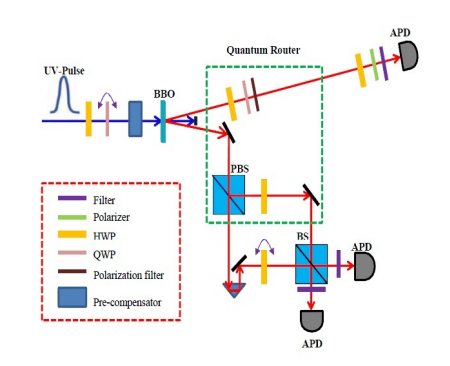
Having perfectly secure communication based on the powerful laws of quantum mechanics would spark a revolution in world-wide communications and data processing. The current generation of quantum cryptography systems are point-to-point connections over a single length of fiber optic cable, so they can send secure messages from point A to point B, but cannot route information onwards to other destinations. Because the act of routing a message requires reading the part of it that indicates where it has to be routed (the header), that part has remained "in the clear". Many scientists are working to develop quantum routers that will fix this problem by steering quantum messages without destroying them.
Instead of sending the 0s and 1s of digital code, quantum communicators can send information in a superposition of states that represent both 0s and 1s at the same time. What’s more, separate quantum objects such as a pair of photons can be entangled, which means they share the same existence even if they are widely separated. That leads to a form of quantum information that has no classical counterpart.
One approach is to encipher the router tables -- as long as the hub is secure, then the network should also be secure. The problem with this approach is scalability. As the number of links increases, it becomes increasingly difficult to handle all the possible connections that can be made between one point in the network and another.
Quantum computers will exponentially increase the power of computing, and we may soon have a network to support them.

Read more at this detailed article.

Saturday, June 16, 2012

Another Quantum Computing Leap

In the recent Science News Magazine, Alexandra Witze reports that long-distance quantum teleportation has succeeded,
In teleportation, two people — physicists call them Alice and Bob — share one each of a pair of entangled particles. Alice measures a property on her particle and sends Bob a note, through regular channels, about what she did. Bob then knows how to alter his own particle to match Alice’s. Bob’s particle then possesses the information that had been contained in Alice’s, which was obliterated by her measurement. Thus the information has been “teleported” from Alice’s lab to Bob’s.
Physicists first teleported quantum information in 1997 using a single pair of entangled photons, or particles of light. Since then researchers have slowly upped the ante, teleporting with larger groups of photons, over longer distances and sometimes using atoms as the entangled particles.

The phenomena of quantum teleportation may help quantum computers function as well as digital computing when doing calculations. Another article describes how this process works,
...researchers manipulated data for the gate using two input qubits, one with the state that would ultimately be read, and the other to be flipped. They also had four more qubits all entangled with one another in a special state that they would use to read and output the results of the gate.
To do the gate operation, they took each of the input qubits and paired it with one of the entangled qubits.... Each pair was then read, or measured... resolving them to some combination of 1 and 0. This process teleported the data of the two input qubits onto the set of four entangled ones.
Because two of the qubits being measured were entangled with the output qubits, the output qubits were resolved too.

Such experiments harken a time when computing power will exceed current trends by, well, a quantum leap.
- Posted by Tom/Bluedog

Location:Silver Spring