Would you give up your car, if a robot would ferry you where you need to go?
According to Brian Johnson in his report Disruptive Mobility, when most vehicles are self-driving he predicts around 2025—new car sales in the U.S. could drop by 40 percent, while the number of cars on American roads could decline by 60 percent to fewer than 100 million. Many see driving as more of a chore than something pleasurable.
Read more in the CS...
Thursday, May 28, 2015

Friday, May 15, 2015
The Merc Lorry is on Nevada Roads, Now the GoogleCar is Roadworthy
Just a year since we saw its self-driving car prototype, Google is ready to go from the test track to public roads in California. The company moves to the next phase of testing, which will see vehicles with removable steering wheels, accelerator and brake pedals undergo the same testing that its modified self-driving Lexus SUVs were put under. Google prototype autonomous vehicles have already racked up "nearly a million autonomous miles" on its test tracks and have recently been driving 10,000 miles on their own each week. Although the idea is for the cars to operate completely free from human interaction, Google says the removable controls are there for a safety driver to take over if required. Of course, Mercedes (Daimler) is charging ahead, with its self-driving truck.

From Engadget: When they do hit the streets of Mountain View, the prototypes will be limited to 25mph. Although they're controlled by the same systems already in use inside its Lexus test models, Google says it wants to "uncover challenges that are unique to a fully self-driving vehicle." This will certainly include monitoring stopping distances and whether it can navigate its way through a congested area, but it will also help the public familiarize themselves with the vehicles. Google may have already overcome the technological obstacles, but ensuring they're accepted by Californians may be an even bigger challenge
Watch the video!

From Engadget: When they do hit the streets of Mountain View, the prototypes will be limited to 25mph. Although they're controlled by the same systems already in use inside its Lexus test models, Google says it wants to "uncover challenges that are unique to a fully self-driving vehicle." This will certainly include monitoring stopping distances and whether it can navigate its way through a congested area, but it will also help the public familiarize themselves with the vehicles. Google may have already overcome the technological obstacles, but ensuring they're accepted by Californians may be an even bigger challenge
Watch the video!
Monday, May 11, 2015
Real-World Accident Rate for Autonomous Cars is Incredibly Low
The US Department of Transportation says about 33,000 people die on America’s roads every year. Enthusiasm for self-driving cars hinges in some part on their potential to reduce accident rates. Self-driving cars are being tested primarily in California and Nevada. With 11 accidents over six years, the Google Car is incredibly free of accidents. In two of the four cases, the car was doing the driving at the time of the crash. In the other two, the person behind the wheel had taken control of the car. The crashes were among the nearly 50 self-driving cars now being operated in California.
Read more here and here...
Tuesday, May 5, 2015
Orbital Espresso? Yes, it is (ha ha) out of this world!
When astronaut Samantha Cristoforetti wants to satisfy the all-too-Italian craving for an espresso, she can so so the way many Earth-bound coffee drinkers do, with the push of a button. Ms. Cristoforetti, the seventh Italian and the first Italian woman to venture into orbit aboard the International Space Station, uses a specially designed machine to create the optimal coffee beverage, high above the rest of us.
LavAzza partnered with Italian space-food supplier Argotec to create the first-ever microgravity capsule brewer, to actually deliver the coffee-maker to the space station. The space station is pressurized to Earth sea level, keeping the boiling temperature of coffee the same as we know it. But there can be no coffee grounds loose, which, in microgravity would quickly dirty up the station. To keep the rig contained with no risk for shorting out delicate scientific equipment while someone tries to draw a delicious crema, the machine has been engineered to European Space Agency and NASA standards.

The an important deviation from sidling up to the bar at a café is that the coffee will be delivered into sealed packets, to contain the liquid.
Hmmm, delicious espresso! Read more here...
LavAzza partnered with Italian space-food supplier Argotec to create the first-ever microgravity capsule brewer, to actually deliver the coffee-maker to the space station. The space station is pressurized to Earth sea level, keeping the boiling temperature of coffee the same as we know it. But there can be no coffee grounds loose, which, in microgravity would quickly dirty up the station. To keep the rig contained with no risk for shorting out delicate scientific equipment while someone tries to draw a delicious crema, the machine has been engineered to European Space Agency and NASA standards.
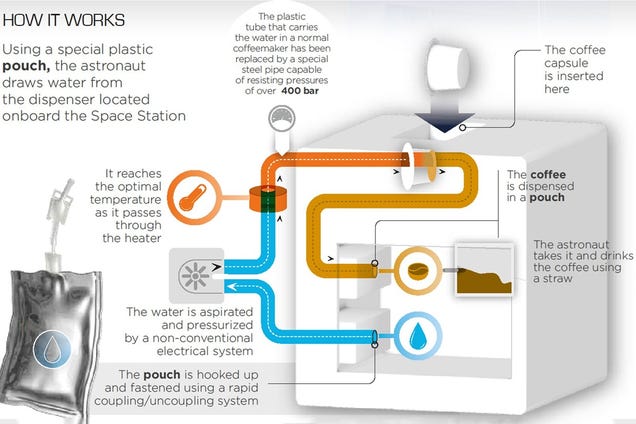
The an important deviation from sidling up to the bar at a café is that the coffee will be delivered into sealed packets, to contain the liquid.
Hmmm, delicious espresso! Read more here...
Friday, May 1, 2015
Bridge Your Solar Load at Night with a TeslaMotors Battery
Tesla is offering a consumer battery, called the Powerwall, priced starting at $3,500, and derived from the batteries the car company uses in its Model S vehicles.
So when it is nighttime, or cloudy, your solar panels are not doing anything. When becalmed, your wind powered generator is idle. With a battery to store the energy produced during peak times, your home will be free of the grid more often. The device, which Tesla will start producing later this year, will be installed by licensed technicians
Read more... TreeHugger
So when it is nighttime, or cloudy, your solar panels are not doing anything. When becalmed, your wind powered generator is idle. With a battery to store the energy produced during peak times, your home will be free of the grid more often. The device, which Tesla will start producing later this year, will be installed by licensed technicians
Read more... TreeHugger
Subscribe to:
Posts (Atom)