Monday, May 11, 2015
Real-World Accident Rate for Autonomous Cars is Incredibly Low
The US Department of Transportation says about 33,000 people die on America’s roads every year. Enthusiasm for self-driving cars hinges in some part on their potential to reduce accident rates. Self-driving cars are being tested primarily in California and Nevada. With 11 accidents over six years, the Google Car is incredibly free of accidents. In two of the four cases, the car was doing the driving at the time of the crash. In the other two, the person behind the wheel had taken control of the car. The crashes were among the nearly 50 self-driving cars now being operated in California.
Read more here and here...

Tuesday, May 5, 2015
Orbital Espresso? Yes, it is (ha ha) out of this world!
When astronaut Samantha Cristoforetti wants to satisfy the all-too-Italian craving for an espresso, she can so so the way many Earth-bound coffee drinkers do, with the push of a button. Ms. Cristoforetti, the seventh Italian and the first Italian woman to venture into orbit aboard the International Space Station, uses a specially designed machine to create the optimal coffee beverage, high above the rest of us.
LavAzza partnered with Italian space-food supplier Argotec to create the first-ever microgravity capsule brewer, to actually deliver the coffee-maker to the space station. The space station is pressurized to Earth sea level, keeping the boiling temperature of coffee the same as we know it. But there can be no coffee grounds loose, which, in microgravity would quickly dirty up the station. To keep the rig contained with no risk for shorting out delicate scientific equipment while someone tries to draw a delicious crema, the machine has been engineered to European Space Agency and NASA standards.

The an important deviation from sidling up to the bar at a café is that the coffee will be delivered into sealed packets, to contain the liquid.
Hmmm, delicious espresso! Read more here...
LavAzza partnered with Italian space-food supplier Argotec to create the first-ever microgravity capsule brewer, to actually deliver the coffee-maker to the space station. The space station is pressurized to Earth sea level, keeping the boiling temperature of coffee the same as we know it. But there can be no coffee grounds loose, which, in microgravity would quickly dirty up the station. To keep the rig contained with no risk for shorting out delicate scientific equipment while someone tries to draw a delicious crema, the machine has been engineered to European Space Agency and NASA standards.
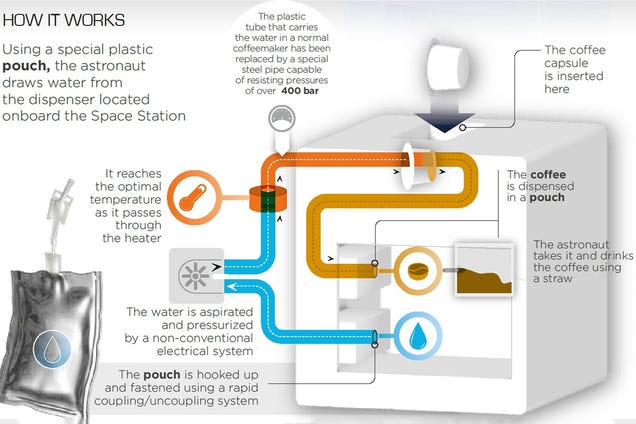
The an important deviation from sidling up to the bar at a café is that the coffee will be delivered into sealed packets, to contain the liquid.
Hmmm, delicious espresso! Read more here...
Friday, May 1, 2015
Bridge Your Solar Load at Night with a TeslaMotors Battery
Tesla is offering a consumer battery, called the Powerwall, priced starting at $3,500, and derived from the batteries the car company uses in its Model S vehicles.
So when it is nighttime, or cloudy, your solar panels are not doing anything. When becalmed, your wind powered generator is idle. With a battery to store the energy produced during peak times, your home will be free of the grid more often. The device, which Tesla will start producing later this year, will be installed by licensed technicians
Read more... TreeHugger
Designing Software That Works for Your Organization
When undertaking a major -- enterprise -- software project, it may be useful to consider Conway’s Law, named for Melvin Conway, which states: Any organization that designs a system (defined broadly) will produce a design whose structure is a copy of the organization's communication structure.
Consider this person's approach: “We should model our teams and our communication structures after the architecture we want.”
I have seen a looming problem for many of my customers: making effective use of big data is impeded by data being scatted around silos, across departments or even teams. At Bluedog, we do not have a top-down model. The management is not hierarchical management, so Workbench doesn't focus on centralized tools or reporting, which many managers see as necessary to control workers. Bluedog's architecture is focused more on the needs of the end users than on the needs of management. Perhaps report proliferation indicates a hunger for data, but difficulty for business analysts to define what is important?
If you've read my books, you know I have seen application structures evolve from the late 1980s from monolithic to modular solutions of this century, using techniques such as encapsulation and abstraction to reduce coupling and increase cohesion. With service oriented architecture, the purpose of doing so is obvious – the results are software systems that are easier to understand, change, reuse, and enhance.
How has Bluedog been successful? We start with as small a team as possible. We avoid making architectural decisions at the top, but keeping the team "understaffed," to reduce the possibility of building complexity, or over-architecting. If possible, we put the developers in the same room as the customers, business analysts, GUI designer, database gurus. Proximity encourages communication.
Monday, April 27, 2015
When Your Service Provider Can Sink Your Business
This is an amazing (and sad) story -- a mid-sized business relies on its web hosting service provider for its web site. Typical, really. But they were also utilizing the hosting service for their entire back-office data -- CRM, accounting, payroll, and more.
Without an understanding of the ramifications -- perhaps lacking even a systems administrator, let alone a CIO -- the company was processing and storing all its data on its website. One day, a developer was optimizing the database and removing records that the business no longer needed (so he thought). But a single, poorly formed delete query wiped out the database table. This minor error in a SQL command deleted the sum of the company's data; the company was rocked to the core. In a few months, they went belly-up.
Lesson: choose a proper SAAS provider that can handle your data properly. Know what you want, what you are getting into, and what happens to your data.
Read more here... Death by Delete
Subscribe to:
Posts (Atom)