Showing posts with label supply chain. Show all posts

Tuesday, July 21, 2020

Oracle or SAP? How about.. neither? Go Open Source for your ERP

Seems like there are two major contenders for an Enterprise Resource Planning (ERP) system, Oracle and SAP. However, there are a number of flexible, feature-rich, and cost-effective open source ERP systems available, as well.

Over at Forbes, we read:

How Do The Core Businesses For Oracle And SAP Compare? Oracle provides products and services that address enterprise information technology environments. The products and services include applications and infrastructure offerings that are delivered worldwide through a variety of flexible and interoperable IT deployment models. These models include on-premise deployments, cloud-based deployments, and hybrid deployments (an approach that combines both on-premise and cloud-based deployment).       Oracle’s geographical revenue mix is strong with 55% coming from the Americas, 29% from EMEA countries (Europe, Middle East, and Africa), and the rest from Asia-Pacific.
   SAP is a multinational software corporation that develops and delivers software, services, and support that address business needs. The company offers a wide range of enterprise resource planning applications which includes customer relationship management, human capital management, financial management, product life-cycle management, and supply chain management. The company also has a foray in business intelligence with SAP BusinessObjects. SAP’s geographical revenue mix is also strong with 44% coming from EMEA countries (Europe, Middle East, and Africa), 40% from the Americas, and rest from Asia-Pacific.

Depending on the organization's needs, more features doesn't always mean better. Further needs may evolve as the business grows, so search for an ERP system that can expand. That could mean the system has additional modules or supports plugins and add-ons.

Most open source ERP systems are web applications that can be downloaded and installed on a server or with a VM image. But if lacking the skills or staff to maintain a system, look for a hosted version of the application. Choose an application that has good documentation and good support, which may be either paid support or an active user community. Some include:

ERPNext is a classic open source projects, featured on Opensource.com in 2014. It was designed to address a particular need, replacing a creaky and expensive proprietary ERP implementations. It includes modules for accounting, managing inventory, sales, purchase, and project management. The applications that make up ERPNext are form-driven—you fill information in a set of fields and let the application do the rest. The whole suite is easy to use.

pache OFBiz's suite of related business tools is built on a common architecture that enables organizations to customize the ERP to their needs. As a result, it's best suited for midsize or large enterprises that have the internal development resources to adapt and integrate it within their existing IT and business processes.

OFBiz is a mature open source ERP system; its website says it's been a top-level Apache project for a decade. Modules are available for accounting, manufacturing, HR, inventory management, catalog management, CRM, and e-commerce. You can also demo out its e-commerce web store and backend.

Odoo is an integrated suite of ERP applications: project management, billing, accounting, inventory management, manufacturing, and purchasing. Those modules can communicate with each other to efficiently and seamlessly exchange information. Odoo provides a friendly, almost spartan, interface. Odoo is a web app, with subscriptions to individual modules, or download the source code from GitHub. It's licensed under LGPLv3.

Solving complicated supply chain or financial management problems for a business doesn’t mean buying a big-money ERP system. While vendors like Oracle and SAP may dominate the market, there are free and open source solutions that can help get an organization digital with little investment.

Thursday, April 30, 2020

Supply Chain Management Systems Are Taking a Beating During this Pandemic

From medical supply shortages to consumers hoarding toilet paper, the links in supply chains are under strain. Can we learn valuable lessons for the future?

For example, design of the medical supply chain in the United States has low stress resilience. In early stages of the pandemic, most hospitals are already experience a shortage of personal protective equipment, such as N95 masks. As COVID19 cases spread, so will scarcity.

Normally, most enterprise resource planning (ERP) solutions can reliably analyze things like inventory levels, historical purchasing trends, and discounts to recommend how much of a product to order. During the worldwide disruption caused by the COVID-19 pandemic, many programs a are making fluctuating recommendations, and adjustments to inputs are occurring more frequently. As this becomes more dynamic, the frequency of monitoring by supply chain managers is increasing. Human interventions into automated systems can have adverse impacts on algorithms.

Most retail companies rely on some type of model or algorithm to help predict customer demand, from a basic Excel spreadsheet or a refined, software engineer-built application. Normally, those models are fairly reliable and work well. But as with virtual all other systems, they are being impacted by the pandemic. On the news, we see how customers may be concerned about having enough access to essentials such as paper towels.

One reason for added stress is that a lot of trade is international -- for example, trade between the US and other countries, particularly China, has been under stress due to the virus. So distributors and retailers have had to find new sources for products.

Machine learning-based algorithms are the foundation of the next generation of ERP, particularly around logistics. We will see the most significant cost efficiencies around advanced resource scheduling. Neural net and A.I.-based methods are the foundation of a broad spectrum of next-generation logistics and supply chain technologies under the hood of the best ERP solutions. Significant gains are being made where machine learning can contribute to addressing complex constraint, cost, and delivery problems organizations face. Automated analysis can help provide significant insights into how supply chain performance can be improved, anticipating anomalies in logistics constraints, and matching "pull" performance before shortages occur.

Another example is using a decentralized supply chain for track-and-trace applications. This would improve performance and reduce costs. A study found that in a 30-node configuration when blockchain is used to share data in real-time across a supplier network, combined with better analytics insight, cost savings appeared to be more than $5 million a year.

Watch this video to learn more, or read this article.

Wednesday, April 8, 2020

Non-Repudiation in Supply Chain Management - Use Case for Blockchain

Supply chains are under strain at the moment -- the fragility of current systems is laid bare during this pandemic crisis. Blockchain, simplified, is a data structure that maintains transactional records and while ensuring security. This decentralized approach ensures — a chain of records which are controlled by no single authority. This enables digital information to be distributed, but not copied, so each individual piece of data can only have one owner. Blockchain is the underlying technology of digital currencies. But it has a multiplicity of uses.

Many call blockchain a “digital ledger” stored in a distributed network. Here is one way to think about how Blockchain works:

“Picture a spreadsheet that is duplicated thousands of times across a network of computers. Then imagine that this network is designed to regularly update this spreadsheet…”

This information is constantly reconciled into a database, which is stored in multiple locations and updated instantly. That means the records are public and verifiable. Since there’s no central location, it harder to disrupt as the data exists simultaneously in millions of places.

In the service of supply chain management, manifests could be secured with this approach. Modern supply chains are complex. A business’ supply chain consists of all the links to creating and distributing it products. Depending on the goods, a supply chain can be extraordinarily complex, spanning numerous stages with multiple geographical (often global) locations. The documentation can consist of a multitude of invoices, statements, payments, bills of lading, etc., and have several individuals and entities involved. The timeframe, even with just-in-time production, can require months for the process to go from raw materials, component construction and assembly, through packaging and distribution.

The idea of using blockchain to streamline workflows for all parties, no matter the size of the business network, is not new. In government procurement, for example, shared infrastructure provides auditors with greater visibility into participants’ activities along the value chain.


The challenges in many supply chains include lack of transparency because data consolidation clouds repudiation. There's a lack of real-time issue resolution resulting in ineffective supply chain risk management. Shocks (as we have seen) result in sudden demand changes -- a "bullwhip" effect that reverberates throughout the vendor ecosystem.

A use case might look like this: instead of having a central intermediary, use blockchain in an Enterprise Resource Planning (ERP) solution to synchronize data and transactions across the network. Each participant verifies the work and calculations of others. This relives the enormous amount of redundancy and crosschecking found in many current systems.

With the right implementation strategy, blockchain has the potential to drive efficiencies, lower costs, and to enhance consumer experience through transparency and traceability.

Monday, November 18, 2019

Achieving Simplicity in a Complex System

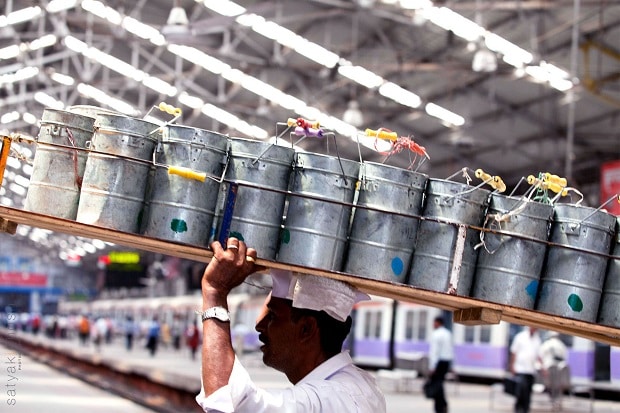
Mumbai is one of the largest cities in the world and an average working professional leaves home pretty early in the day to take the local train to commute to the work. Each day approximately 4,000 dabbawallahs deliver almost 250,000 home-cooked meals (for late breakfast and lunch) from the kitchens of suburban wives and mothers direct to workers in “the world’s most ingenious meal distribution system.”

The foot soldiers are Dabbawallahs, who pick up the home-cooked lunches in the suburbs, hop on trains, and deliver them, on foot or bike, to office workers in Mumbai. Later on, they pick up and bring back the same empty tiffins (the name for the metal containers used).

The tiffins consist of several stacked aluminum boxes with a carry-handle. Each container carries individual portions that separate curry dishes, bread, rice, desserts, and more. This means multiple courses. Tiffins come in several different compartments so as to separate starter, mains, and dessert. The tiffin serves to keep food in its original shape - no bruised fruit or mashed roti. The tiffin’s handle is at the top, keeping everything upright when being carried. Home-cooked meals are economical and can be more healthy.


While the system seems very complicated, it is the coming together of many elements, including the railway system in Mumbai. The dabbawallah rely on the train to deliver the lunch boxes around the city. Stefan Thomke, the Harvard Business School professor studied the system: “[the railway] sort of helps them in unexpected ways. It synchronizes the system because in Mumbai the railway is one of the few things that always runs on time. It forces the entire organization to run according to a rhythm.”

Another example of how simplicity aids the dabbawallah system is  the labeling of the tiffins. There’s very little information coded on the boxes. “For example, there’s no return address,” says Thomke, “but these boxes have to go back to the person who gave them to you.”  The simple color coding system acts as an identification system for the destination and recipient and origin of the tiffin.

The Dabbawala Association has been in business for over last 125 years. In 1998, Forbes Magazine recognized its reliability to match the Six Sigma standard. This means that the dabbawalas make less than 1 mistake in every 6 million deliveries. Be it a Steve Jobs or Picasso, all the great artists always had a penchant for simplicity. Value and efficiency is maintained by  keeping to basics. The process is very lean and uncomplicated. And the customer is the most important cog in this machine.

Read more here