Showing posts with label aircraft. Show all posts

Friday, August 6, 2021

VTOL Electric Personal Aircraft

Tetra Aviation is preparing its Mk-5 eVTOL Aircraft for flight in 2022. The lightweight electric aircraft is designed for single-person use and is crafted from a combination of aluminum and carbon-fiber-reinforced polymers, with the prototype measuring in at prototype measures at 28 feet wide, 20 feet long, and 1,000 pounds, A total of 32 vertical lift rotors across four wings lift the plane, while horizontal thrust propels it forward.


See more over at... their site

Saturday, April 3, 2021

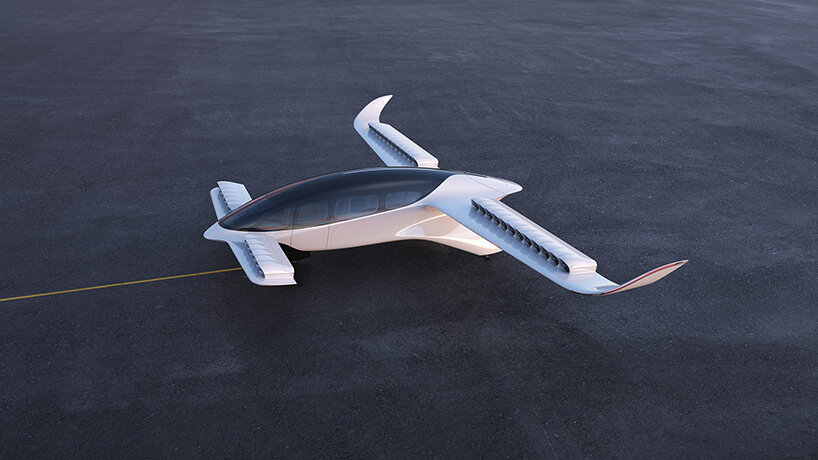
lilium VTOL flying taxi


German company lilium has unveiled the design of its 7-seater jet which aims to revolutionize regional travel, saving people hours. The aircraft is capable of vertical take-off, quietly, allowing the company to access plenty landing sites and the opportunity to build higher network density, avoiding expensive ground infrastructure.

The aircraft has cruise speed of 175 mph at 10,000 feet and has a range of 155 miles, including reserves. planned to launch operations in 2024, the aircraft features ducted electric vectored thrust (DEVT). This flight system is integrated into the wing flaps -- electric jet engines provide advantages in payload, aerodynamic efficiency and a lower noise profile, while also providing thrust vector control to maneuver the lilium jet through every phase of flight.

Lilium flies with "electric jets", throwing out a non-combustion compression stream of air. The Lilium's ducted fan is an example of a wider class of ducted propulsor. They all work the same way, to accelerate air in one direction so that the reaction force pushes the fan or propeller in the other. If the blade disc were used to provide compression, the device would not be a propulsor but a compressor and would not exit to the free air stream.


Read more here...


Wednesday, December 2, 2020

What Every Happened with the Drone Sightings at Gatwick?

Short answer: not much.

Around 9pm on Wednesday December 19, 2018, a security guard observed two drones inside the security perimeter at Gatwick Airport,  Unauthorized drone activity is considered a danger to aircraft and passengers due to the risk of collision. Within minutes, Gatwick’s only runway had been closed and all flights were suspended -- the full details are documented here.

The Gatwick drone incident was the first time a major airport was shut down by drones. The unknowns -- was this a terrorism incident, or just random overflight by irresponsible parties -- remain. Two years on, the perpetrators remain unidentified, despite a law enforcement operation that lasted 18 months, cost £800,000 and involved five different organizations.

Without evidence – or any leads or convincing motives – Sussex police and Gatwick maintain it was a sophisticated, malicious, and well-planned attack. In other circles. the Gatwick drone has become a punchline, with doubts of the drones' very existence.

Read more at the Guardian...

Friday, November 6, 2020

Need to Get Around in Barcelona? Take a Robot Helo-Taxi

Enaire, Spain’s air navigation authority, has announced plans to begin demonstrating flying taxis in Barcelona and Santiago de Compostela in 2022.

“We need to move urban mobility into the third dimension: airspace. And we need to do it as efficiently and sustainably as we can,” the authority’s director general, Ángel Luis Arias, told an online conference this week.

 Ehang, a Chinese drone company, announced a new product at CES it's calling the Ehang 184, an all electric quadcopter scaled up from a drone so that it's large enough to carry a passenger. Ehang calls it an autonomous aerial vehicle, I prefer personal pilotless helicopter, but if you need to explain what it is to anyone, just say it's a driverless car for the sky.

Ehang says the 184, which is all electric, can carry a single passenger up to 10 miles or roughly 23 minutes of flight. The person in the cockpit doesn’t do any piloting, they just input their destination and enjoy the ride. The aircraft claims to be able to autonomously take off, fly a route, sense obstacles, and land. And if anything goes wrong, a human pilot is supposed to step in and take over the controls from a remote command station.Read 

more over at the Guardian...


Monday, August 31, 2020

Skynet is on its way - AI wins against human fighter pilot in DARPA dogfight

As we read over at some military news site,

DARPA's AlphaDogfight trials have officially come to a close with Heron Systems' incredible artificial intelligence pilot system defeating not only its industry competitors, but going on to secure 5 straight victories against a highly trained U.S. Air Force F-16 pilot, without the human pilot scoring a single hit.

This should not be confused with the Intelligent Flight Control System (IFCS), a next-generation flight control system designed to provide increased safety for the crew and passengers of aircraft as well as to optimize the aircraft performance under normal conditions. What is most valuable to 99% of the rest of the world -- outside of military applications -- is regarding passenger planes which fly autonomously. Software would have to be capable of handling emergency situations. At present, modern airliners do a good job of flying automatically until something unexpected happens. At that point, a pilot takes control and typically resolves the problem. Very rarely, though, a pilot must act to save the aircraft from catastrophe. 

There's more details about autonomous flight over at the I-triple-E, Application of AI Methods to Aircraft Guidance and Control.


Thursday, October 10, 2019

Boeing Wins at the WTO against Airbus

The World Trade Organization (WTO) found in favor of Boeing and the U.S. in retaliation for the unlawful EU subsidization of Airbus. The October 2, 2019, $7.5 billion annual award is the largest made, and comes after almost 15 years of litigation at the WTO. The U.S. successfully argued that the EU / four of its member states conferred more than $18 billion to Airbus in subsidized financing.

This entitles the U.S. to impose an additional 10 percent duty (tariff) on airplanes from France, Germany, Spain, and the United Kingdom, as well as an additional 25 percent duty on certain goods including single malt Irish and Scotch whiskies, coffee from Germany, cheeses from several countries, and certain garments from the United Kingdom.

EU officials claim to have little interest for mutual imposition of countermeasures. They have emphasized that such countermeasures strain transatlantic trade relations and inflict damage on citizens and businesses. The timing of the new tariffs is politically sensitive given the recent global imposition of national security tariffs by the U.S. on steel and aluminum, as well as the potential addition of global national security tariffs on automobiles and parts.

Read more here...

Monday, April 29, 2019

How Software Was Egregiously (and Poorly) Used to Hide Major Engineering Deficiencies

In this article on IEEE Spectrum, we read:

It is astounding that no one who wrote the MCAS software for the 737 Max seems even to have raised the possibility of using multiple inputs, including the opposite angle-of-attack sensor, in the computer's determination of an impending stall. As a lifetime member of the software development fraternity, I don't know what toxic combination of inexperience, hubris, or lack of cultural understanding led to this mistake. But I do know that it's indicative of a much deeper problem. The people who wrote the code for the original MCAS system were obviously terribly far out of their league and did not know it.
So Boeing produced a dynamically unstable airframe, the 737 Max. That is big strike No. 1. Boeing then tried to mask the 737's dynamic instability with a software system. Big strike No. 2. Finally, the software relied on systems known for their propensity to fail (angle-of-attack indicators) and did not appear to include even rudimentary provisions to cross-check the outputs of the angle-of-attack sensor against other sensors, or even the other angle-of-attack sensor. Big strike No. 3... None of the above should have passed muster. None of the above should have passed the "OK" pencil of the most junior engineering staff... That's not a big strike. That's a political, social, economic, and technical sin... 
The 737 Max saga teaches us not only about the limits of technology and the risks of complexity, it teaches us about our real priorities. Today, safety doesn't come first -- money comes first, and safety's only utility in that regard is in helping to keep the money coming. The problem is getting worse because our devices are increasingly dominated by something that's all too easy to manipulate: software.... I believe the relative ease -- not to mention the lack of tangible cost -- of software updates has created a cultural laziness within the software engineering community. Moreover, because more and more of the hardware that we create is monitored and controlled by software, that cultural laziness is now creeping into hardware engineering -- like building airliners. Less thought is now given to getting a design correct and simple up front because it's so easy to fix what you didn't get right later.
The article also reveals that: "not letting the pilot regain control by pulling back on the column was an explicit design decision. Because if the pilots could pull up the nose when MCAS said it should go down, why have MCAS at all?  ...MCAS is implemented in the flight management computer, even at times when the autopilot is turned off, when the pilots think they are flying the plane." 

Wednesday, July 5, 2017

Osprey-Like Drone with Variable Angle Thrust

A traditional quadcopter is designed to achieve 6 degrees of freedom — three translational and three rotational — and piloting these manually can prove to be a challenge for beginners. Hexacopters offer better stability and flight speed at a higher price but the flight controller gets a bit more complex.

Read more...

Friday, March 24, 2017

FLying in circles is bad... Landing in circles, on the other hand...

We know additional airports are difficult to build, and are the mercy of wind directions and speeds when it comes to takeoffs and landings. Limit to their capacity can also cause delays. The Endless Runway Circular Airport is a new concept that would use a circular, 3.5 km banked runway to ensure planes always land and take off with a headwind. Big enough to fit even a major hub airport inside, it would also take up less space than some conventional layouts, allow up to three planes to take off or land at once, and seamlessly adjust to the conditions outside without needing to make runway changes.

Read about the project here... and check out BBC's article here...

Thursday, February 16, 2017

Goodbye Screens, Hello Choice (and less legroom)

Airlines have figured out we don't want to watch little screens with four crappy films...

The screens and their wiring add weight to the plane, and when fuel prices are high, every pound makes a difference. Another financial incentive: Without the screens, carriers can install slimmer seats, which means they can accommodate more passengers and earn more money, Brett Snyder, the author of the airline industry blog “Cranky Flier,” said in an interview.

“Rise of in-flight Wi-Fi aside, the zero screen purchases made by Southwest aligns with the fact that many of the carrier’s flights are shorter in duration than the time it takes to finish a movie,” he said, as reported in the NYT.

Tuesday, May 10, 2016

Package Delivery via Drone: faster, cheaper

Read about how DHL's drone delivery will make getting packages to remote places more cost-effective:

The latest version of DHL's delivery drone has made more than 100 successful deliveries and can get parcels to remote villages faster than transporting them across difficult terrain in a car. The third generation of the company's Parcelcopter completed a three month test period of autonomously carrying parcels to and from set locations in Bavaria, Germany.

Wednesday, April 27, 2016

The Titanium Bathtub vs the Software-Wacky Boondoggle

The Air Force is offering up a showdown between the A-10 and the F-35. We know which will triumph! The Titanium Bathtub vs the CooCoo Boondoggle

From Wikipedia:
The Fairchild Republic A-10 Thunderbolt II is an American twin-engine, straight wing jet aircraft developed by Fairchild-Republic in the 1970s. It entered service in 1976, and is the only United States Air Force production-built aircraft designed solely for close air support, i.e. close quarters support of ground troops. This includes attacking tanks, armored vehicles, and other ground targets. The A-10 was effective in Operation Desert Storm during the Gulf War. It has also served in combat in the Balkans, Afghanistan, Iraq, and against the Islamic State in the middle east.
The A-10 was intended to improve on the performance of the A-1 Skyraider and its poor firepower. The A-10 was designed around the 30 mm GAU-8 Avenger rotary cannon that is its primary armament. Its airframe was designed for durability, with measures such as 1,200 pounds (540 kg) of titanium armor to protect the cockpit and aircraft systems, enabling it to absorb a significant amount of damage and continue flying. Its short takeoff and landing capability permits operation from airstrips close to the front lines, and its simple design enables maintenance with minimal facilities. The A-10A single-seat variant was the only version produced, though one A-10A was converted to an A-10B twin-seat version. In 2005, a program was begun to upgrade remaining A-10A aircraft to the A-10C configuration with modern avionics for use of GPS guided weaponry and a Helmet Mounted Cueing System.
The A-10's official name comes from the Republic P-47 Thunderbolt of World War II, a fighter that was particularly effective at close air support. The A-10 is more commonly known by its nicknames "Warthog" or "Hog". Its secondary mission is to provide forward air controller - airborne (FAC-A) support, by directing other aircraft in attacks on ground targets. Aircraft used primarily in this role are designated OA-10. With a variety of upgrades and wing replacements, the A-10's service life may be extended to 2028.


The Lockheed Martin F-35 Lightning II is a family of single-seat, single-engine, all-weather stealth multirole fighters undergoing final development and testing by the United States. The fifth generation combat aircraft is designed to perform ground attack and air defense missions. The F-35 has three main models: the F-35A conventional takeoff and landing (CTOL) variant, the F-35B short take-off and vertical-landing (STOVL) variant, and the F-35C carrier-based Catapult Assisted Take-Off But Arrested Recovery (CATOBAR) variant. On 31 July 2015, the first squadron was declared ready for deployment after intensive testing by the United States.
The F-35 is descended from the X-35, which was the winning design of the Joint Strike Fighter (JSF) program. It is being designed and built by an aerospace industry team led by Lockheed Martin. Other major F-35 industry partners include Northrop Grumman, Pratt & Whitney and BAE Systems. The F-35 took its first flight on 15 December 2006. The United States plans to buy 2,457 aircraft. The F-35 variants are intended to provide the bulk of the manned tactical airpower of the U.S. Air Force, Navy and the Marine Corps over the coming decades. Deliveries of the F-35 for the U.S. military are scheduled to be completed in 2037[16] with a projected service life up to 2070.
The program is the most expensive military weapons system in history, and it has been the object of much criticism from those inside and outside government — in the US and in allied countries.[20] Critics argue that the plane is "plagued with design flaws," with many blaming the procurement process in which Lockheed was allowed "to design, test, and produce the F-35 all at the same time, instead of ... [identifying and fixing] defects before firing up its production line."[20] By 2014, the program was "$163 billion over budget [and] seven years behind schedule." Critics further contend that the program's high sunk costs and political momentum make it "too big to kill."