Showing posts with label history. Show all posts

Thursday, September 17, 2020

Bronze Age Europeans Couldn't Drink Milk, It Seems

About 3,000 years ago, thousands of warriors fought on the banks of the Tollense river in northern Germany. They wielded weapons of wood, stone, and bronze to deadly effect: Over the past decade, archaeologists have unearthed the skeletal remains of hundreds of people buried in marshy soil. It's one of the largest prehistoric conflicts ever discovered. Now, genetic testing of the skeletons reveals the homelands of the warriors—and unearths a shocker about early European diets: These soldiers couldn't digest fresh milk...

The results leave scientists more puzzled than ever about exactly when and why Europeans began to drink milk. "Natural genetic drift can't explain it, and there's no evidence that it was population turnover either," says Christina Warinner, a geneticist at Harvard University and the Max Planck Institute for the Science of Human History who was not involved with the study. "It's almost embarrassing that this is the strongest example of selection we have and we can't really explain it."

Perhaps something about fresh milk helped people ward off disease in the increasingly crowded and pathogen-ridden European towns and villages of the Iron Age and Roman period, says the study's co-author. But he admits he's baffled too. "We have to find a reason why you need this drink."

Monday, April 15, 2019

This day - April 16, 1178 BCE - was the Return of Odysseus to Ithaca after his Travels

On this day, in 1178 BCE, Odysseus arrived in Ithaca, having begun his way home when the Trojan War ended. He had served ten years as one of the most distinguished leaders of the Greeks. His voyage was fraught with perils: the Cyclopes, Sirens, Scylla and Charybdis, and other obstacles.

Read about it at https://en.wikipedia.org/wiki/Odyssey#Homecoming


Friday, December 8, 2017

Meteoric Iron was the Source of Bronze Age Weapons and More

It appears iron from meteorites was used widely to make knives and other artifacts. Previous studies had found specific Bronze Age objects to be made from meteoric metal – such as a dagger buried with King Tutankhamun. This research addresses the question of just how widespread the practice was.

Bronze was the metal of choice for tools, weapons, and jewelry during the Bronze Age – hence the era's name – which began around 3300 BCE. The alloy was durable and easily available, made by smelting copper and mixing it with tin and other metals.

Read more...

Wednesday, March 16, 2016

Cities are the source of civilization -- perhaps time to supersede nation-states?

Forward looking individuals are inviting the world’s mayors to collaborate on solving some of humanity’s most vexing problems – Benjamin Barber, Don Tapscott and Richard Florida – who believe that our times and circumstances require nothing less than a global parliament of mayors. This would be a voluntary network of elected municipal officials and others, managed by collaboration and consensus, to advocate for more effective urban policy. Cities, after all, are the birthplace of civilization, and hubs of innovation.

The Global Parliament of Mayors is an unprecedented new experiment in democratic global governance platform by, for, and of cities. Mayors from cities large and small, North and South, developed and emerging, will convene in September 2016 to identify and pursue in common the public goods of citizens around the world

Tapscott is best known for a series of successful business books touting the benefits of collaboration technology, chief among them the 2006 Wikinomics, while Florida is known for his theory of the “creative class”; and Barber has significant experience thinking through the dynamics of democratic governance.

At the Guardian:

We do in fact live in a post-Keynesian epoch – an era in which, for reasons both fiscal and nakedly ideological, most states have retreated from the provision of citizen services they used to undertake as a matter of course. Margaret Thatcher’s sweeping logic of privatisation has had such impact that even egalitarian Finns are now worried about losing their national health service.

Municipal administrators, by contrast – beset by rising waters, crumbling infrastructure and vulnerable populations – are forced to be practical, empirical, and far more immediately accessible to their restive and squabbling constituencies. They don’t enjoy the luxury of ideological posturing. Anyone interested in pragmatic, sleeves-up responses to the various crises that afflict us might therefore be well-advised to look to them for insight.


See this site for more about the Parliament of Mayors

Thursday, December 4, 2014

East vs west, individualism vs collectivism


Cited from a recented New York Times article by T. M. Luhrmann -- some cultures are more individualistic, and others more interdependent. Agriculture may explain why. Some interesting -- if broadly reached -- conclusions based on an anthropologic view. I'm unsure there's sufficient evidence to support ALL the conclusions the author of this NYT article jumps to, but certainly the idea that individual-achievement vs the-collective-good is a worthy thought problem.

Why Are Some Cultures More Individualistic Than Others?

AMERICANS and Europeans stand out from the rest of the world for our sense of ourselves as individuals. We like to think of ourselves as unique, autonomous, self-motivated, self-made. As the anthropologist Clifford Geertzobserved, this is a peculiar idea.

People in the rest of the world are more likely to understand themselves as interwoven with other people — as interdependent, not independent. In such social worlds, your goal is to fit in and adjust yourself to others, not to stand out. People imagine themselves as part of a larger whole — threads in a web, not lone horsemen on the frontier. In America, we say that the squeaky wheel gets the grease. In Japan, people say that the nail that stands up gets hammered down.

These are broad brush strokes, but the research demonstrating the differences is remarkably robust and it shows that they have far-reaching consequences. The social psychologist Richard E. Nisbett and his colleagues found that these different orientations toward independence and interdependence affected cognitive processing. For example, Americans are more likely to ignore the context, and Asians to attend to it. Show an image of a large fish swimming among other fish and seaweed fronds, and the Americans will remember the single central fish first. That’s what sticks in their minds. Japanese viewers will begin their recall with the background. They’ll also remember more about the seaweed and other objects in the scene.

Another social psychologist, Hazel Rose Markus, asked people arriving at San Francisco International Airport to fill out a survey and offered them a handful of pens to use, for example four orange and one green; those of European descent more often chose the one pen that stood out, while the Asians chose the one more like the others.

Dr. Markus and her colleagues found that these differences could affect health. Negative affect — feeling bad about yourself — has big, persistent consequences for your body if you are a Westerner. Those effects are less powerful if you are Japanese, possibly because the Japanese are more likely to attribute the feelings to their larger situation and not to blame themselves.

There’s some truth to the modernization hypothesis — that as social worlds become wealthier, they also become more individualistic — but it does not explain the persistent interdependent style of Japan, South Korea and Hong Kong.

In May, the journal Science published a study, led by a young University of Virginia psychologist, Thomas Talhelm, that ascribed these different orientations to the social worlds created by wheat farming and rice farming. Rice is a finicky crop. Because rice paddies need standing water, they require complex irrigation systems that have to be built and drained each year. One farmer’s water use affects his neighbor’s yield. A community of rice farmers needs to work together in tightly integrated ways.

Not wheat farmers. Wheat needs only rainfall, not irrigation. To plant and harvest it takes half as much work as rice does, and substantially less coordination and cooperation. And historically, Europeans have been wheat farmers and Asians have grown rice.

The authors of the study in Science argue that over thousands of years, rice- and wheat-growing societies developed distinctive cultures: “You do not need to farm rice yourself to inherit rice culture.”

Their test case was China, where the Yangtze River divides northern wheat growers from southern rice growers. The researchers gave Han Chinese from these different regions a series of tasks. They asked, for example, which two of these three belonged together: a bus, a train and train tracks? More analytical, context-insensitive thinkers (the wheat growers) paired the bus and train, because they belong to the same abstract category. More holistic, context-sensitive thinkers (the rice growers) paired the train and train tracks, because they work together.

Asked to draw their social networks, wheat-region subjects drew themselves larger than they drew their friends; subjects from rice-growing regions drew their friends larger than themselves. Asked to describe how they’d behave if a friend caused them to lose money in a business, subjects from the rice region punished their friends less than subjects from the wheat region did. Those in the wheat provinces held more patents; those in the rice provinces had a lower rate of divorce.

Sunday, July 20, 2014

Lest We Forget - We Have Walked on the Moon

On July 20, 1969, astronauts Neil Armstrong and Buzz Aldrin became the first humans to walk on the moon -- go Team America! The scope of NASA's Apollo program seems staggering today. President Kennedy announced his moon goal just four years into the Space Age, but the United States had not even launched a human into orbit yet. Amazingly, just eight years later...

Twenty-four U.S. astronauts have traveled to the Moon. Three have made the trip twice, and twelve have walked on its surface. Apollo 8 was a lunar-orbit-only mission, Apollo 10 included undocking and Descent Orbit Insertion (DOI), followed by LM staging to CSM redocking, while Apollo 13, originally scheduled as a landing, ended up as a lunar fly-by. Apollo 7 and Apollo 9 never left Earth orbit. The inherent dangers of manned Moon expeditions as seen with Apollo 13 -- and of course the disaster of Apollo 1, the first manned mission of the U.S. The planned low Earth orbital test of the Apollo Command/Service Module never made its target launch date of February 21, 1967 because a cabin fire during a launch rehearsal test on January 27 at Cape Canaveral Air Force Station Launch Complex 34 killed all three crew members—Command Pilot Virgil I. "Gus" Grissom, Senior Pilot Edward H. White II and Pilot Roger B. Chaffee—and destroyed the Command Module.


Tuesday, June 24, 2014

Remember Bannockburn

While everyone remembers Guy Fawkes day, I like to remember the 24th of June, anniversary of the Battle of Bannockburn. No rhyme, but a crucial lesson, regardless.

On this day some 700 years ago, the Scots were aiming for independence. Thinking outside the box, Robert the Bruce had his sappers dig a field of scores of holes, each only a few feet wide and deep, but excavated at a crucial point where the English were advancing. These small traps, capable of snapping horse's legs, meant the cavalry had to stay on the narrow Roman road. Unable to spread into a proper formation, they were left vulnerable.

While the battle ended well for the Scots, the war of independence dragged on. And, in the end, we all know how that worked out. perhaps wankers colonized Scotland, but history, well, history is written by the winners.

Lesson: act today with fortitude and cleverness — even in the face of certain disaster. Although, of course, the outcome may not matter in the long run.

Wednesday, December 11, 2013

Time Magazine - More In Touch than the Nobel Peace Prize

Time Magazine has named Pope Francis as "Person of the Year" -- the third pope so honored as Time’s Person of the Year (Pope John Paul II made the cover in 1994 and Pope John XXIII made the cover in 1962). Lilian Cunningham at the WaPo writes,

By the judgement of Time’s editorial staff, the pope–elected earlier this year after a surprise resignation by predecessor Pope Benedict–was the most influential global newsmaker of the past 12 months. Earlier this week, Time narrowed the finalists down to ten, then five. Pope Francis ultimately won out over Edward Snowden, Syrian president Bashar Assad, Texas senator Ted Cruz and gay rights activist Edith Windsor.
The magazine first released such a cover in 1927 under the name “Man of the Year,” and conferred the title on Charles Lindbergh for his solo trans-Atlantic flight. Since then, the annual covers have featured global peacemakers, U.S. presidents, tech billionaires, dictators and more amorphous concepts, like “the protestor” and “the endangered earth.” The editors’ intention is not to praise the figures selected, but to acknowledge their influence in shaping the news and history of the outgoing year. (Hence why Adolph Hitler made the cover in 1938.)
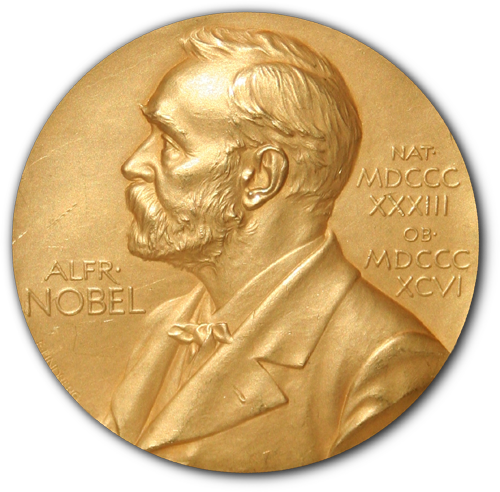
The magazine's cover story sometimes seems to make more sense than the actions of the Nobel Peace Prize committee, who have turned this esteemed artifact into a political football. At The Economist, recognizing an institution (Organization for the Prohibition of Chemical Weapons -- a very noble cause, of course) and not a person reduces the heroic nature of past laureates, like Nelson Mandela (1993). This award seems consistent with the recent mediocre underwhelming recent winners (last year, the European Union or Barak Obama (2009), who had been president for just 12 days before nominations). The magazine's chart of past prizes calls out this pattern of suspect winners. An organization, not a person, won the fourth year. In an enlightened sign, the first woman won a year later. Yet non-Westerners weren’t recognized until the 1970s.


Why do such awards matter? Calling attention to those who do "good" (or, in the case of Time's criteria, just "do" important things, good or evil) in the world is important to the health of our combined human psyche. Dark days continue, economically and socially, around the world. When the person who invented an awesome tool -- used for both good and evil -- is humanistic enough to dedicate his earning to fostering peace, we should take the assignment of that prize with gravitas.

Thursday, October 17, 2013

Could Flight be Man's Greatest Achievement?

While the Wright Brothers were first out the gate successfully, to complete man's eternal quest to achieve a powered flight, in 100 years we have come very far. The short flight in 1901 changed air travel in the twentieth century and remains one of human kind's great technical achievements. Of course, this culminated in one giant step, and a smaller one.

This is a cool article, about the language of the skies...

Aviation has a lot of special language, like sailing or gymnastics. Its brief, even curt efficiency and orderly templates keep planes on course and out of each other’s way.... But there is one special set of aviation jargon, more alien than the concocted vocabulary of Esperanto and more bizarre than patterned wordplay of Pig Latin or Id. This is the lexicon of waypoints, which are the road markers in the sky for directing planes on a course.

In the 20th century, airplanes and mass-­produced cars have changed the way we live. Cars, affordable for masses, have allowed us to move around, and planes make faraway destinations close. People still struggle towards a century-old dream -- the merging of cars and planes into flying cars. But, as readers know, self-driving cars are, in my opinion, much closer at hand, and a better option. I love flying, but I'll settle for a robot chauffeur.

Monday, January 16, 2012

Why learning stuff matters, part 103


I have always thought the British were totally awesome in WWII, standing up to ultimate evil. Even when the odds were against them, and they were on their own. I love stories of how they flipped the proverbial bird to the Nazis whenever possible.

In 1941, a Major Alexis Casdagli was taken prisoner by the Germans and sent to a series of prison camps. He practiced needlepoint to pass the time; this piece he created in December 1941 looks innocent enough, indeed it looked so innocent that guards allowed him to hang it on the walls at all the camps he stayed in. However the piece contains two subversive messages coded into the borders, messages that if they had been discovered by guards would have put his life at risk.

So taking time to learn Morse Code can pay off...

Read the full story...or here...